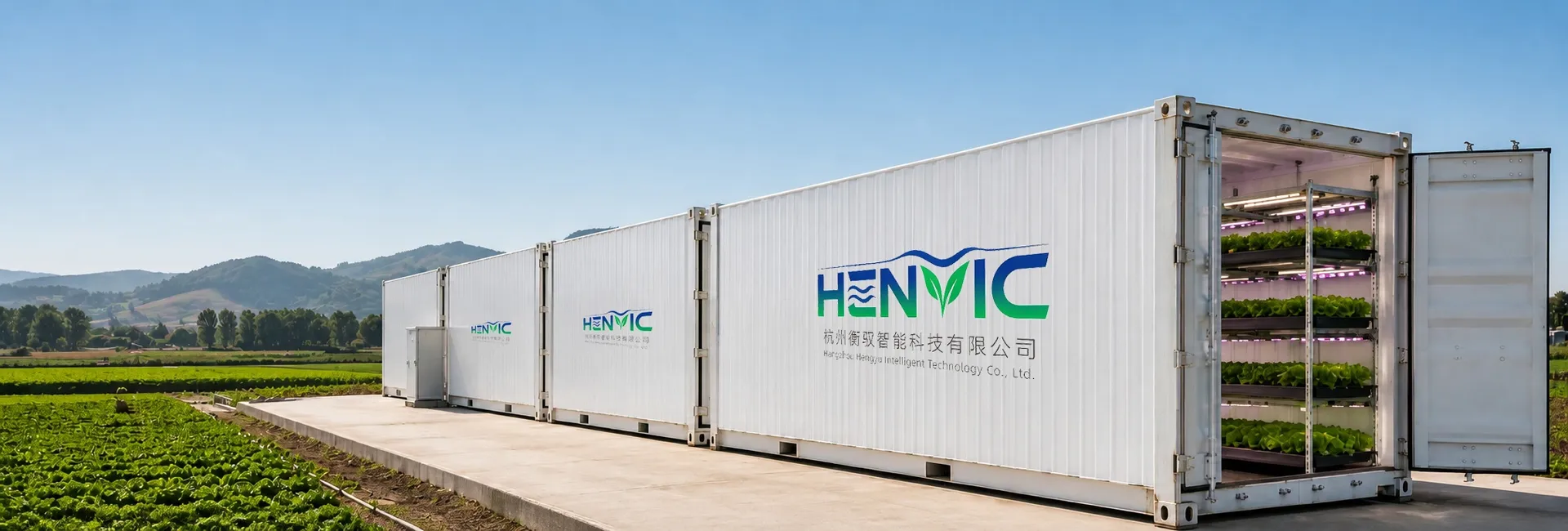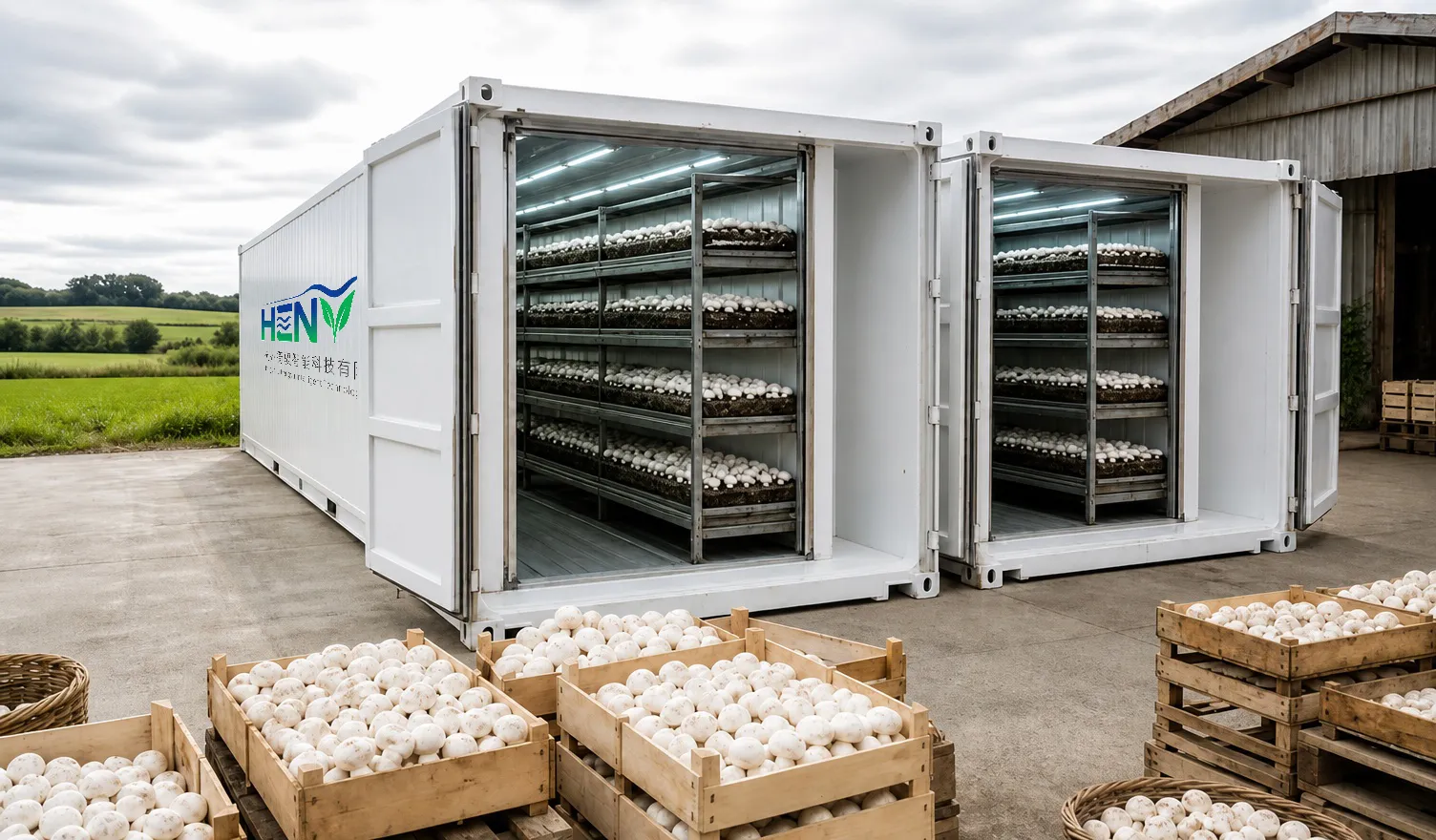
A 40-foot container offers roughly 55–65 m² of usable growing area across four to six tiers, and every square metre carries 120–200 W of LED input power. The refrigeration plant therefore faces a load that is almost entirely artificial, continuous and latent-dominated. Systems sized on the sensible lighting load alone run short of dehumidification capacity from about the second week of production, when the canopy closes and transpiration reaches its peak.
The sensible/latent split is the single number that determines whether a container farm works. In a closed canopy under 200–300 µmol/m²/s and a VPD of 0.6–0.8 kPa, lettuce transpires roughly 1.5–2.5 L per m² of canopy per day; culinary herbs under higher PPFD run 3–4 L. Converting that to an instantaneous load, 2 L/m²/day over 50 m² is 100 L/day of water vapour, or about 2.8 kW of latent heat at steady state, against perhaps 6–8 kW of sensible lighting load. The total coil load is not the difficulty. The difficulty is that the latent fraction must be removed without overcooling the room, because a coil that dehumidifies by cooling below dewpoint delivers air at 8–10 °C and the space will not tolerate it.
This is the reheat trap. Condensing units sized for 7 °C supply air will hold temperature and fail on humidity, and the operator's response — lowering the setpoint — simply increases the sensible removal and drives the space colder and no drier. The correct architecture at container scale is either a dedicated dehumidification coil with neutral-air delivery (a heat-pipe or run-around arrangement, or a coil fed by a separate medium-temperature circuit), or mechanical dehumidification with the condenser heat rejected into the supply air stream so that the process is nearly isothermal. Desiccant wheels handle the latent load independently of the coil but add regeneration energy that can approach the lighting load on a small unit, and their performance collapses when the return air is above 80% RH.
Setpoint discipline matters as much as equipment selection. VPD, not relative humidity, is the control target, because the same 70% RH at 18 °C and at 24 °C represent very different transpiration pressures. A well-tuned container farm runs VPD in a band of 0.5–0.9 kPa for lettuce and leafy herbs, drifting toward the upper end during the photoperiod and relaxing at night to limit tipburn and calcium-related disorders. Controlling on VPD means the humidity sensor must be accurate to ±2% RH and calibrated quarterly; cheap capacitive sensors drift several points within a season and the resulting VPD error is enough to produce tipburn in a crop that looked fine on paper.
Air distribution is the other half of the problem, and it is where retrofits usually fail. A container is a narrow duct with a high aspect ratio, and the natural tendency is for cold supply air to fall down the walls while warm, humid air stratifies at the ceiling. Multi-tier racks compound this: the top tier sees supply air first and the bottom tier sees air that has already picked up sensible heat and moisture from three canopies above it. The practical answer is a plenum distribution system — perforated ducts or fabric socks running the length of the container at each tier level — with a target face velocity of 0.3–0.5 m/s across the canopy and no dead zones below 0.2 m/s. Horizontal airflow along the tiers, rather than down through them, gives more uniform VPD because it strips the boundary layer without dumping cold air directly on the growing point.
Finally, CO₂ and ventilation interact with the humidity design in ways that are usually neglected. Sealed operation with enrichment to 800–1200 ppm is incompatible with high air-change rates, so the dehumidification strategy cannot rely on ventilation to remove moisture. Conversely, adding fresh air for ethylene or CO₂ control imports a latent load that varies with the weather outside and can exceed the internal load on a humid day. Container farms in tropical locations should be designed with a dedicated fresh-air unit that dehumidifies before admitting air, and the enthalpy of that stream belongs in the load calculation from the outset.