A Technical Guide to Species Selection and Environmental Control
Mushrooms are unique among cultivated organisms: they do not rely on light for energy. As heterotrophs, they consume organic substrate and require darkness or near-darkness for fruiting, making them ideal candidates for controlled-environment cultivation chambers. Where leafy greens and vine crops demand intense lighting, mushroom chambers demand precise darkness, high humidity and disciplined gas management. The result is a production system that can run vertically, stacked in layers, in a sealed container, and yield dozens of kilograms per square meter per cycle. But not all mushrooms thrive under the same conditions. Species selection is the first and most consequential decision in chamber design, and it determines the required temperature, humidity, ventilation and substrate strategy. This article surveys the mushroom species best suited to chamber cultivation and the technical parameters that make them productive.
Why Mushrooms Thrive in Chambers
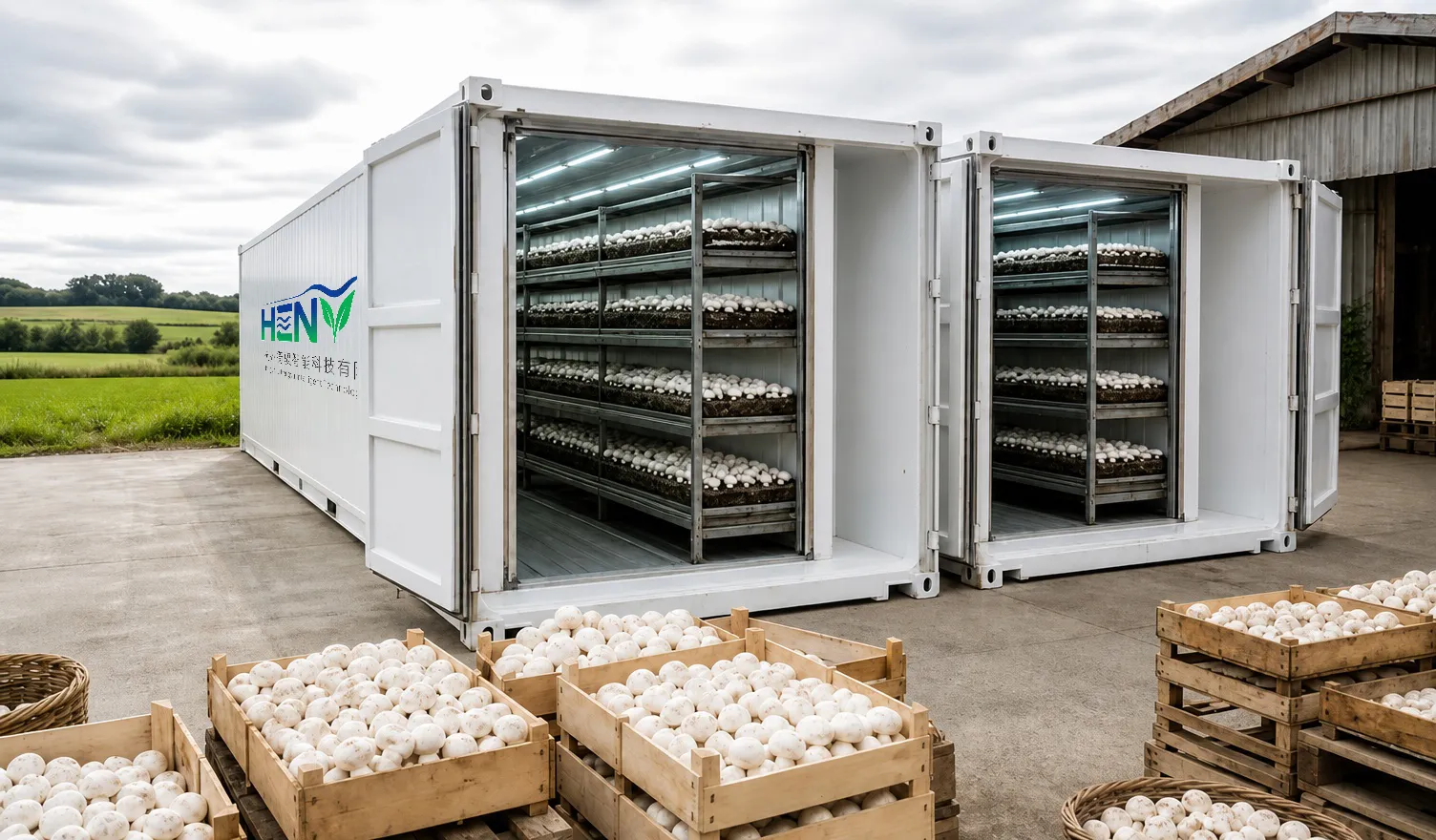
Mushroom cultivation is divided into two phases: spawn run (mycelial colonization of the substrate) and fruiting (pinning and harvest). Both phases are highly sensitive to temperature, relative humidity, carbon dioxide and air exchange. A cultivation chamber allows growers to hold each variable within narrow bands, eliminating the seasonal variability, pest pressure and weather dependence that limit conventional mushroom houses. Chambers also enable stacked, multi-layer racking, raising yield per square meter by several times compared with single-floor tunnels or sheds. In addition, the enclosed environment simplifies sterilization, contamination control and automation, which are especially critical in commercial production where a single spore of competitor mold can ruin a crop.
Core Environmental Parameters
Temperature and relative humidity are the primary levers. Most mushroom chambers maintain 22–26 °C during spawn run, then lower to 15–20 °C for fruiting, depending on species. Relative humidity must stay high—typically 85–95% during fruiting—because mushrooms transpire heavily through the cap and gills. Carbon dioxide is the most species-specific parameter: oyster mushrooms demand aggressive fresh-air exchange and low CO2 (below 800 ppm), while enoki requires very high CO2 (around 10,000 ppm) to force the elongated stem and suppressed cap that buyers expect. Light is minimal; many fruiting mushrooms need only dim or no light, while light-stimulated species such as brown shiitake require a short exposure at the pinning stage. Air velocity and exchange rate determine the rate of CO2 removal and humidity regulation, and are adjusted per species and stage.
The Core Cultivable Species
Oyster Mushrooms (Pleurotus ostreatus, P. eryngii, P. nebrodensis)
Oyster mushrooms are the most widely grown species in chambers. They colonize rapidly—mycelium can cover a substrate in two to three weeks—and fruit aggressively across a wide temperature range. Pleurotus ostreatus, the common oyster, fruits at 10–22 °C and tolerates CO2 levels below 800 ppm; its gray, white and pink strains are all commercially grown. Pleurotus eryngii, the king oyster, is prized for its thick stem and high protein content; it fruits at 12–18 °C and requires slightly more substrate depth. Pleurotus nebrodensis, the "brain mushroom" of Mount Nebrodi, is a white, cold-tolerant species favored in China and high-end markets. Oyster mushrooms grow on many substrates—cottonseed hulls, corn cobs, sawdust, straw and coffee grounds—making them the most flexible and beginner-friendly choice for chamber cultivation.
Button and Brown Mushrooms (Agaricus bisporus)
The button mushroom is the most commercially important mushroom in the world, and chamber cultivation has become the global standard for its production. It requires the most demanding environmental control of any common species: casing soil, a highly specific compost (the "phase III" process, pasteurized at high temperatures), and precise CO2 management. During spawn run, CO2 is kept high (around 0.5–1%) to encourage mycelial growth and long stipes; at pinning, CO2 must drop sharply to 400–600 ppm to stimulate cap development and prevent elongated stems. Temperatures are maintained at 24–26 °C for mycelium and 16–18 °C for fruiting. Humidity is typically 85–90%. Agaricus is so well-suited to chambers that the largest production facilities—often in the Netherlands, Poland and China—are essentially industrialized chamber farms, with automated casing, harvesting and grading. Brown varieties (cremini, portobello) are the same species with a longer incubation and slightly higher cap maturity.
Shiitake (Lentinula edodes)
Shiitake is the second most widely cultivated mushroom globally, prized for flavor and bioactive polysaccharides. It is more demanding than oyster mushrooms: it requires a hardwood substrate (oak, beech, hornbeam), a longer colonization period (two to four months), and lower fruiting temperatures (10–18 °C). Light is essential at pinning—shiitake needs 200–500 lux for 12 hours to form properly shaped, brown caps. CO2 must be kept below 800 ppm, or the stems will elongate and caps remain small. The brown-capped "donko" and "kinkome" strains are high-value varieties that justify the longer cycle. Shiitake is well-suited to chambers that provide light control, making it a premium species for chambers rather than bulk production.
Enoki (Flammulina velutipes)
Enoki is a specialty species whose distinctive appearance—white, long stem, small cap—is entirely the product of high CO2 cultivation. In a chamber, CO2 is maintained at 8,000–10,000 ppm during fruiting, suppressing cap growth and stimulating stem elongation. Temperature is kept low (5–10 °C), light is dim, and humidity high. The cultivar is typically a white strain, grown on a synthetic casing or substrate in bottle culture. Enoki chambers require very tight CO2 control and are among the most technically demanding mainstream species. Yield per square meter can be high, and prices are premium, making enoki a favorite for high-value urban and container farms.
Beech Mushroom or Buna-shimeji (Hypsizygus tessellatus / marmoreus)
The beech mushroom is a premium, sweet-flavored variety well-suited to chambers. It fruits at 12–16 °C, prefers high humidity (85–95%), and requires moderate CO2 (below 1,000 ppm) for good stem formation. Its mycelium is vigorous, and the fruiting body is clustered, making it amenable to bottle or bag culture. It is a good candidate for high-value, clean-label production.
Nameko (Pholiota nameko)
Nameko is a slimy, orange-brown mushroom popular in Japanese cuisine, especially in soups. It fruits at 10–15 °C, requires high humidity, and grows on hardwood sawdust. Its cultivation in chambers is increasingly common because the slime layer must be preserved, which requires careful humidity and handling. It is well suited to container or bag-based chambers.
Nameko, Koekitaro, and Other Specialty Species
Nameko (Pholiota nameko) is a slimy, orange-brown mushroom popular in Japanese cuisine, especially in soups. It fruits at 10–15 °C, requires high humidity, and grows on hardwood sawdust. Its cultivation in chambers is increasingly common because the slime layer must be preserved, which requires careful humidity and handling. It is well suited to container or bag-based chambers. Other specialty species, such as kawaratake (Stropharia rugosoannulata, the wine cap), koekitaro (Lentinus kawakamii), and abalone mushrooms (Pleurotus abalonus), are also cultivated in chambers for their distinctive textures, flavors, or medicinal properties.
Medicinal and Functional Species: Reishi (Ganoderma lingzhi), Turkey Tail (Coriolus versicolor), and Lion's Mane (Hericium erinaceus)
Medicinal species are increasingly grown in chambers. Ganoderma lingzhi, the reishi mushroom, is cultivated for its triterpenes and polysaccharides; it grows on hardwood logs or sawdust, fruits at 22–28 °C, and requires high humidity and moderate light. Turkey tail (Coriolus versicolor) is grown for its immunomodulatory beta-glucans; it fruits at 22–25 °C and requires high humidity and low light. Lion's mane (Hericium erinaceus) is cultivated for its erinacines and hericenones, which are studied for neuroprotective effects; it fruits at 18–22 °C, requires high humidity, and produces striking white, spine-covered fruiting bodies. These species are grown in specialized chambers with tighter environmental control, often in research or production settings, and their yields and bioactive content can be optimized through chamber conditions.
Chamber Types and Substrate Strategies
Chamber design follows the species and production model. The simplest is the bag or bottle system, where pre-inoculated substrate bags are hung on racks and moved into a fruiting chamber; this is standard for oyster mushrooms, shiitake, enoki, and button mushrooms. Bag systems are highly automatable, with minimal handling and high throughput. Bottle systems, used for enoki and button mushrooms, allow precise control of humidity and CO2 around each cluster and facilitate mechanical harvesting. For larger fruiting bodies such as king oyster, shiitake, and reishi, shelf or bed systems are used, where substrate bags or logs are arranged on shelves and the fruiting environment is controlled at the room level.
Substrate preparation is equally important. Most species require a carbon-rich substrate: hardwood sawdust for shiitake, oak and beech for king oyster, cottonseed hulls for button mushrooms, and corn cobs or straw for oyster mushrooms. Substrate sterilization (steaming or pasteurization) and inoculation must be done under clean conditions, and the chamber must maintain sterility through positive pressure, HEPA filtration, and frequent surface disinfection. For medicinal species, substrate quality and composition can affect bioactive content, so researchers optimize substrate formulations and nutrient supplementation for each species.
Automation, Data and Yield
Modern mushroom chambers integrate sensors, actuators, and software to manage temperature, humidity, CO2, and air exchange automatically. The IoT layer tracks environmental parameters in real time, and algorithms adjust ventilation and humidification based on stage, species, and fruiting density. Yield per square meter varies by species: oyster mushrooms can produce 15–25 kg per square meter per cycle; button mushrooms, 25–35 kg; shiitake, 10–20 kg; enoki, 20–30 kg, depending on strain and management. The high yields and consistent quality of chamber production have made mushroom cultivation one of the most profitable segments of controlled-environment agriculture.
Choosing the Right Species for a Chamber
Species selection depends on several factors: local market demand, climate, substrate availability, technical capability, and investment level. Oyster mushrooms are the most flexible and fastest-to-market, and they are ideal for entry-level chambers. Button mushrooms are the highest-volume, most industrialized, and require the most sophisticated environmental control. Shiitake and king oyster are premium species with higher prices and longer cycles, and are suitable for chambers with light control. Enoki is a high-value specialty that requires very tight CO2 control and is best for experienced growers. Medicinal species, such as reishi, turkey tail, and lion's mane, are grown in specialized chambers for their bioactive compounds, and their yields and quality can be optimized through precise environmental control.
The Future: Precision, Automation and Diversification
The future of mushroom cultivation chambers lies in precision, automation, and diversification. As sensors become cheaper and algorithms more sophisticated, chambers can be tailored to each species and even to each fruiting stage, optimizing yield, quality, and energy efficiency. Automation—robotic harvesting, grading, and substrate handling—will reduce labor costs and improve consistency. And diversification—growing multiple species in the same chamber using different racks, substrates, and environmental zones—will allow growers to serve multiple markets and reduce risk. As the global appetite for mushrooms—for food, medicine, and wellness—continues to grow, mushroom cultivation chambers will increasingly become the technology that makes it possible to grow more mushrooms, in more places, with less environmental impact.
Conclusion
Mushroom cultivation chambers have transformed mushroom production from a seasonal, open-field activity into a high-yield, year-round, controlled-environment industry. By selecting the right species and managing the environment precisely—temperature, humidity, CO2, light, and substrate—growers can produce a wide range of mushrooms with superior quality, consistency, and yield. From oyster mushrooms to button mushrooms, from shiitake to enoki, from medicinal reishi to lion's mane, the chamber is the technology that makes each species thrive. As the industry continues to evolve, mushroom cultivation chambers will play an increasingly central role in feeding the world with one of its most nutritious and versatile foods.