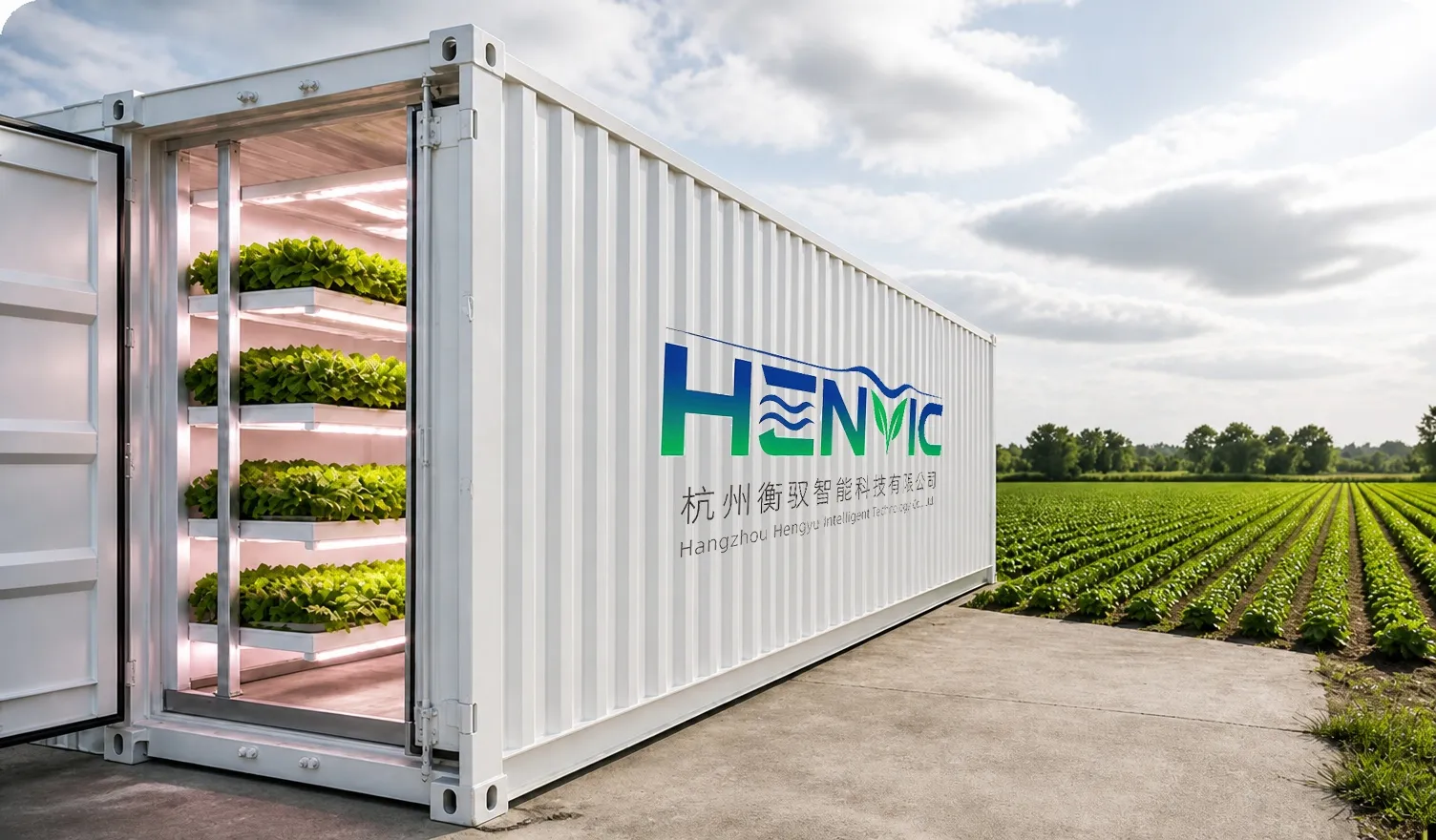
Strip a farm of its two oldest dependencies — soil and sky — and you are left with a box, a power supply, and a software stack. That is precisely what a container farm is: a standard shipping container sealed, insulated, and filled with vertical racks, LED arrays, and recirculating nutrient solution, holding every environmental variable inside a narrow band. It needs no arable land, no rainfall, no sunlight, and no growing season. The claim sounds like a manifesto. The honest question is narrower and more useful: once you remove land and weather from the equation, what is actually left to constrain the model — and how far can it travel on what remains?
The Bargain at the Center of It
Every controlled environment agriculture (CEA) system makes the same exchange, and container farms make it in its most extreme form. A field receives sunlight, rain, and soil fertility at no cost, and pays for them with unpredictability: drought, frost, pests, and a harvest date chosen by nature. A container farm inverts the deal. It buys light, cooling, ventilation, and nutrient delivery, and receives in return something a field can never provide — total authority over the growing environment.
That inversion is the whole story. It explains why container farms produce leafy greens rather than wheat. It explains why electricity, not labor, is the dominant cost. And it explains why the model can be described as converting agriculture into an industrial process: once light, temperature, humidity, CO₂, and nutrient delivery are all programmable, plant growth stops being an agricultural outcome and becomes a setpoint.
The liberating part is genuine. Land ceases to be a prerequisite — the farm fits on a rooftop, a parking lot, a warehouse bay, a barge, a polar research station. Weather ceases to be a risk — there is no weather inside the box. Season ceases to be a schedule — harvests run year-round, and annual crop turns can run several times what a field achieves. In water-scarce regions, the recirculating loop cuts consumption to a small fraction of conventional irrigation. In places where fresh produce is otherwise impossible to obtain at any price, the model does not compete with conventional agriculture; it replaces nothing and creates something new.
Where the Constraint Moves To
Removing land and weather does not remove constraints. It relocates them — from geography to engineering, from nature to economics. Four of them define the boundary.
Energy becomes the binding limit. Lighting, cooling, and dehumidification dominate operating cost, and they are not incidental overhead — they are the direct replacement for resources the sun once provided free. Nearly all of the electrical energy delivered to the LEDs ends up as heat, and the plants add transpiration on top of it, so the lighting decision and the climate control load are a single thermodynamic problem. This is why the model's economics are acutely sensitive to local power prices, and why its carbon footprint is essentially a function of the local grid mix. Cheap electricity plus a high-value crop works. Expensive electricity plus a commodity crop does not, and no amount of automation changes the arithmetic.
Crop range stays narrow. Container farms excel with short, fast-cycling, low-growing, high-value plants — leafy greens, herbs, microgreens, some berries. Staple grains and calorie-dense crops are not economically viable in this format and are not close to being so, because vertical stacking multiplies floor productivity rather than energy efficiency: the more tiers you add, the more light you must pay for. Claims that container farms can feed a city are overstatements. The model supplies freshness, consistency, and quality — not calories at scale.
Complexity is a real operating cost. A container farm is a system that must be maintained as a system. Sensors drift, chillers fail, pH and EC slowly wander, nozzles clog, software has bugs. A pump failure in a nutrient film system can dry an entire tier in hours. Much of the sector's attrition traces to operational complexity rather than horticultural difficulty, and the skill set required — electrical, refrigeration, nutrient chemistry, data monitoring — is genuinely different from conventional farming.
Capital intensity resists scale. The upfront investment is substantial, and expanding means adding containers, which means multiplying HVAC and electrical infrastructure. Industrial processes usually improve economically with size; replicating discrete boxes does not automatically deliver that effect.
How Far It Goes
Read against those limits, the credible applications are specific rather than sweeping, and each one is defined by where the substitution pays off.
Urban and peri-urban fresh supply, where production migrates back toward consumption. The container spends hours in transit instead of days, which shortens supply chains, cuts spoilage, and preserves quality. It is dependence on the electrical grid rather than independence from systems — a trade, not an escape.
Remote and extreme environments — polar stations, offshore platforms, military installations, disaster-relief contexts — where freshness is otherwise unavailable and the cost comparison is not against field produce but against nothing.
Propagation and seedling nurseries, where controlled conditions improve uniformity and survival rates before transplant.
Research and pharmaceutical crops, where precise control over secondary metabolites matters more than cost per kilogram, and where dynamic spectrum control can steer flavor, color, or active-compound content in ways open-field growing cannot.
Education and demonstration, because a container farm is an unusually legible object — people can walk inside the system that feeds them.
And the direction of travel is consistent: lighting efficiency keeps improving, which attacks the largest cost line directly; spectrum control is moving from fixed recipes toward dynamic, crop-specific light programs; predictive control is beginning to anticipate thermal and humidity loads rather than react to them; renewable integration is improving the emissions profile; and fleet management is emerging, where dozens of units share recipes and learning simultaneously.
The Real Answer to "How Far"
The container farm will not replace agriculture, and it was never going to. What it demonstrates is narrower and more interesting: that the oldest dependencies in farming — ground and climate — can be renegotiated, and that photosynthesis can be disassembled into measurable inputs and managed as an industrial process. Both of those are genuine achievements.
But removing land and weather does not make farming free. It converts the cost from hectares and seasons into kilowatt-hours and capital, and it moves the constraint from the field to the balance sheet. How far the model goes depends entirely on two numbers — the price of a kilowatt-hour and the market value of the crop — and on the distance between the container and the people eating what it grows. That is the horizon, and it is set by economics rather than engineering.