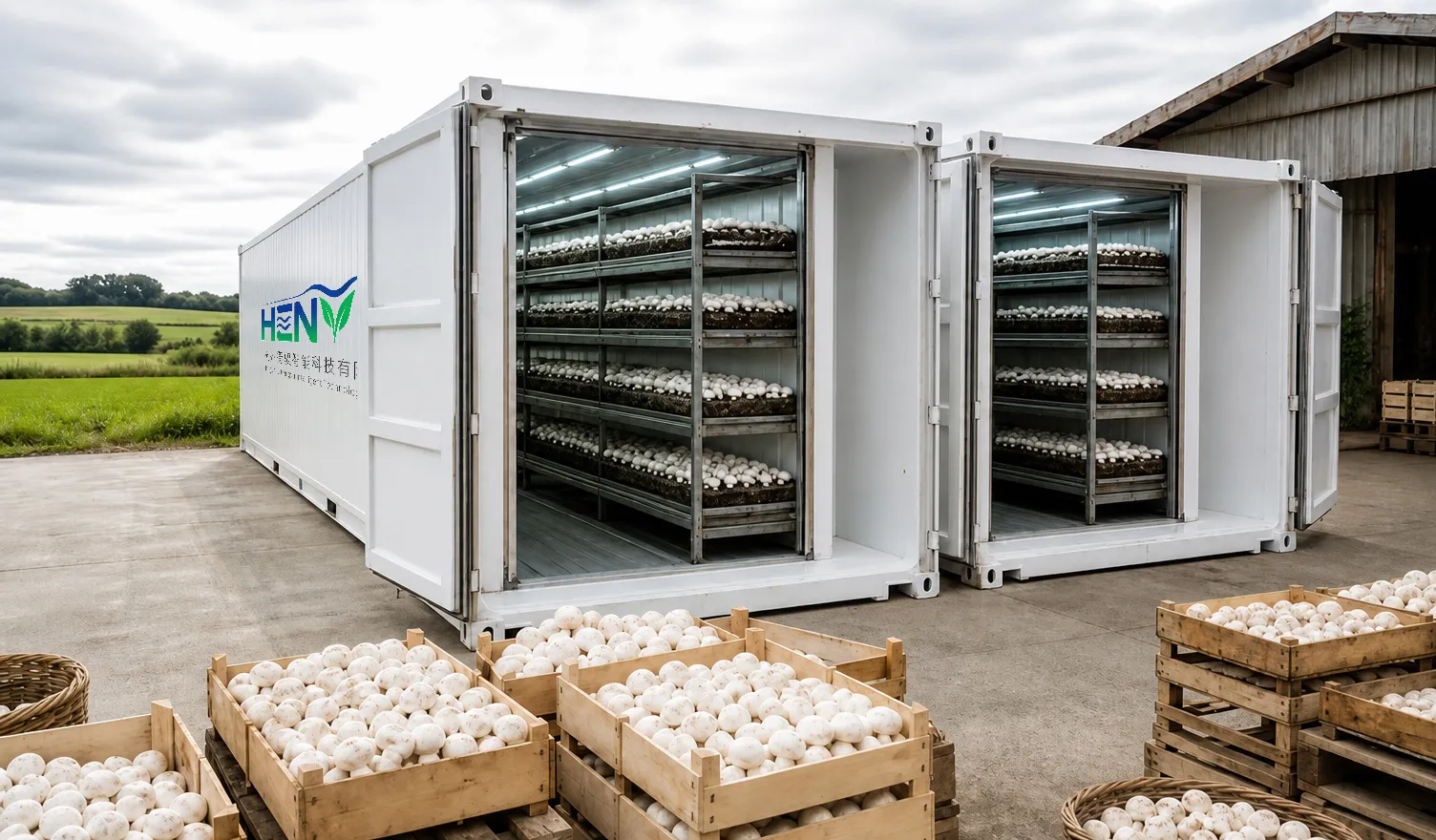
Inside a mushroom container, the two variables that determine product quality are both waste products of the crop's own metabolism. Mushrooms respire continuously, consuming oxygen, releasing carbon dioxide and transpiring water. In a sealed volume with a tightly controlled envelope, those outputs accumulate fast, and their concentrations govern morphology and yield more directly than any setpoint a grower chooses. Managing them is the central engineering problem of the facility.
Respiration as the Governing Process
A fruiting block is metabolically active around the clock. The substrate is being broken down, energy is being released as heat, and every kilogram of dry matter consumed produces a substantial volume of carbon dioxide and a corresponding quantity of water vapour. Heat, gas and moisture are all released together, which means the climate system must handle three loads that scale with the same biological activity.
This coupling is what makes mushroom climate control distinct from plant climate control. In a leafy-green unit, transpiration is driven by vapour pressure deficit and is therefore partially controllable through humidity setpoint. In a mushroom house, the CO2 load is biological and largely fixed by the mass of fruiting tissue in the room. The system cannot negotiate with it; it can only remove it.
Carbon Dioxide and Morphogenesis
The concentration of carbon dioxide in the fruiting chamber governs the shape of the crop. Mushrooms evolved to grow in the interstitial spaces of forest litter, where CO2 levels are elevated and light is scarce. High CO2 signals a dense, obstructed environment, and the organism responds by elongating its stem to push the cap toward open air. The result is the familiar stretched morphology: long, thin stipes, small caps, pale colour.
Below roughly 1,000 parts per million, morphology is normal for most cultivated species. Between 1,000 and 2,000 parts per million, elongation begins. Above that, defects become commercially significant, and quality grading suffers.
The relationship is exploitable in both directions. Enoki growers deliberately hold elevated CO2 to produce long-stemmed bundles. Most other crops are held low. But even where the target is low, precise control matters, because the concentration in a sealed container can drift upward within hours if the exchange system falters. This is why CO2 monitoring should be continuous rather than periodic, and why the sensing points should be distributed rather than located at a single wall position — stratification within a stacked rack system is real, and the concentration in a dead zone between tiers can differ materially from the bulk value.
Relative Humidity and the More Useful Variable
Humidity in a mushroom chamber is conventionally specified as relative humidity in the 85 to 90 per cent band. That specification is convenient but incomplete, because relative humidity is a function of temperature: the same absolute moisture content yields very different relative humidity as air warms or cools.
The variable that actually governs the crop's water relations is vapour pressure deficit — the difference between the saturation vapour pressure at the tissue surface and the actual vapour pressure of the surrounding air. A low vapour pressure deficit means the air has little capacity to draw moisture from the mushroom, which is what is wanted: fruiting bodies are roughly ninety per cent water, have no protective cuticle, and will lose moisture and quality quickly if the air is drying.
Controlling to vapour pressure deficit rather than to relative humidity unifies temperature and humidity into a single target and prevents the situation in which a temperature adjustment silently moves the crop out of its physiological band.
The Dehumidification Paradox
Here is where the mushroom container diverges most sharply from the plant container, and where the environmental plant becomes more complex rather than less.
Cooling air below its dew point condenses water out of it. That is how a conventional air-conditioned space controls humidity, and it is how a leafy-green container holds its setpoints. A mushroom chamber requires the reverse: the cooling coil must run at capacity to remove respiratory heat, while the air it has just dried must be brought back to 85 to 90 per cent relative humidity.
The two requirements are structurally opposed. Running the coil harder dries the air further; reducing the coil to preserve moisture allows heat to build. Neither compromise is acceptable at the extremes, so the system must resolve the conflict architecturally.
Two approaches work. The sequential method cools with a coil, then reheats the air slightly to restore its moisture-holding capacity, then adds moisture back with ultrasonic or high-pressure fogging nozzles. The reheating step looks wasteful — it adds energy to air that was just cooled — but it is thermodynamically necessary if the coil is going to dehumidify and the room is going to stay humid. Heat recovered from the refrigeration discharge can supply it, which converts an apparent loss into reuse.
The functional-separation method decouples the loops entirely: a dry cooling surface handles sensible heat, and a separate humidification system handles moisture, so that neither interferes with the other. This is cleaner in principle and more expensive in hardware, and it is the standard architecture in facilities that cannot tolerate humidity excursions.
Air Exchange and Its Energy Penalty
Because carbon dioxide must be flushed continuously, a mushroom container moves a large volume of outside air. That air arrives at whatever temperature and humidity the weather provides, and it must be conditioned to the room's setpoint before it enters the growing volume.
In winter, incoming air is cold and dry: it must be heated and humidified. In summer, incoming air is warm and wet: it must be chilled and dehumidified. Either way, the fresh-air system becomes a major energy consumer, and its scale is a genuine design tension. Too little exchange and carbon dioxide accumulates until morphology degrades; too much and the climate system cannot hold humidity against the constant influx of unconditioned air.
Heat recovery on the exhaust stream is close to mandatory for economic operation. A plate or rotary exchanger between exhaust and intake recovers a substantial fraction of the sensible energy that would otherwise be lost, and in cold climates the recovery pays for itself quickly.
Instrumentation and the Control Loop
Mushroom climate control requires more sensing than the crop count would suggest. Carbon dioxide sensors at multiple heights within the racking, temperature and humidity probes positioned to represent canopy conditions rather than wall conditions, and ideally a moisture measurement on the exhaust stream to quantify the actual vapour load being removed.
The control logic must coordinate cooling, reheating, humidification, fresh-air dampers and exhaust fans as a single system. Treating them as independent loops produces the characteristic failure mode of a mushroom house: the cooling system and the humidifier running simultaneously against each other, each undoing the other's work at maximum energy cost.
The practical aim is a controller that resolves conflicts by priority — CO2 above all, then temperature, then humidity — and that schedules fresh-air introduction to coincide with periods of lowest conditioning cost where the biological cycle allows it.
The Constraint That Defines the Box
The mushroom container's engineering is defined less by what it must provide than by what it must remove: heat, carbon dioxide and water vapour, all produced continuously by the crop and all capable of degrading it within a short window. The lighting system in this facility is nearly free. The climate system is where the money, the complexity and the risk all sit.